
Is AI Actually Useful for Small Businesses? An Honest Answer
The volume of enthusiasm around artificial intelligence right now is, depending on your perspective, either exciting or exhausting. Probably both.
Every week brings a new announcement about how AI is going to transform some aspect of business. Every conference has three panels on it. Every software vendor has added “AI-powered” to their product descriptions. And somewhere in among all of that noise, if you’re running a small business, you’re trying to work out whether any of this is actually relevant to you or whether it’s mostly large-company technology being sold to a small-company audience.
The honest answer is: some of it is genuinely useful, some of it is overhyped, and the difference between the two is worth understanding.
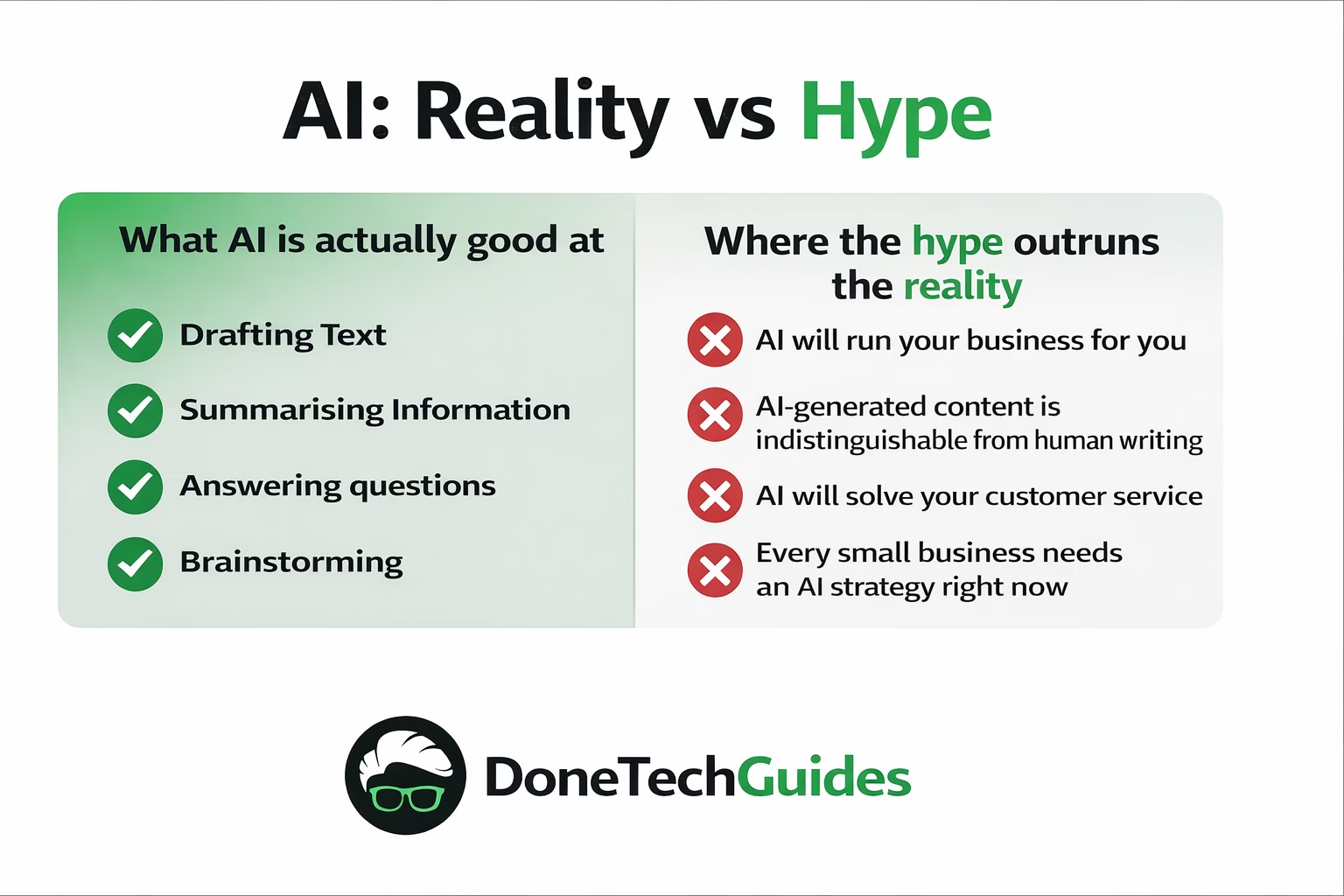
What AI Is Actually Good At Right Now
Let’s start with what works, because there are things that genuinely work.
Drafting text. This is probably the most consistently useful application for small businesses. First drafts of emails, quotes, proposals, website copy, social media posts, job descriptions, policy documents, and meeting agendas. AI tools are reasonably capable at generating workable first drafts that you then edit and improve. The key phrase there is “first draft.” What you get back isn’t finished work, but it’s often a better starting point than a blank page.
For anyone who finds writing time-consuming or difficult, this is a real time saving. For anyone who writes fluently anyway, it’s more marginal but even then, having something to react to is sometimes faster than starting from scratch. DOn’t expect it to do your job, but it can super charge productivity.
Summarising information. Feed an AI tool a lengthy document, a meeting transcript, or a dense article, and ask it to summarise the key points. It does this well. For business owners who regularly receive long reports, lengthy supplier communications, or complex regulatory guidance, being able to get a two-paragraph summary before deciding whether to read the full document is useful.
Answering questions. Not every question needs a Google search, a phone call, or an email to a specialist. A surprising number of “how does this work” and “what are the options here” questions can be answered well enough by a capable AI tool. The important caveat is that AI tools can be confidently wrong, so anything consequential like legal questions, medical questions, financial decisions, needs verification from a qualified source. For lower-stakes questions, they’re often adequate and much faster than the alternatives.
Brainstorming. Stuck on what to call something, how to approach a difficult conversation, what the potential objections to a proposal might be, or how to structure a presentation? AI tools are decent thinking partners for generative tasks. They won’t replace your own judgement, but they can get you unstuck.
Where the Hype Outruns the Reality
“AI will run your business for you.” No. The current generation of AI tools are good at specific tasks that you define and review. They’re not capable of judgment, strategy, or the kind of contextual understanding that running a business actually requires. Anything that markets itself as “autonomous” or “hands-off” should be approached with significant scepticism.
“AI-generated content is indistinguishable from human writing.” Sometimes, in specific contexts. Often, it’s slightly off in ways that are hard to pin down but are noticeable to readers. AI-written content that goes out unreviewed tends to feel generic, occasionally inaccurate, and lacking the specific voice and expertise that makes communication from a real business actually effective. Review everything.
“AI will solve your customer service.” AI chatbots can handle a narrow range of simple, predictable queries. They struggle with anything unusual, emotionally charged, or that requires actual knowledge of your specific business. For many small businesses, the personal service element is a genuine competitive advantage. Replacing it with a chatbot that frustrates customers is not an obvious improvement.
“Every small business needs an AI strategy right now.” You need to understand what AI tools are being used in your business, and what your basic expectations are for staff using them. A formal strategy with a roadmap and KPIs is optional for most small businesses at this stage of the technology’s development.
The Risks Worth Being Aware Of
Data. Anything you paste into an AI tool, or upload to one, is leaving your systems. For consumer versions of these tools, that data may be used to train future versions of the model. For business-grade versions, protections are generally better. The principle to apply is don’t put information into an AI tool that you wouldn’t be comfortable appearing elsewhere.
Accuracy. AI tools generate plausible-sounding content. They don’t always generate accurate content. They can invent facts, misremember information, or confidently present something incorrect. Review anything consequential carefully.
Overdependence. There’s a version of AI adoption where staff stop developing their own skills in areas where AI can assist. Keep the balance right, AI as an assistant to capable people, not a substitute for developing capability.
A Practical Starting Point
If you’re wondering where to actually begin, here’s a sensible approach. Pick one task that a member of your team does regularly and finds time-consuming like drafting a particular type of communication, summarising supplier information, generating first-pass marketing content, and try using an AI tool for it for a month. Review the output critically. See whether it’s saving time and producing acceptable quality. Adjust based on what you learn.
That’s more useful than a comprehensive AI strategy document. Start small, evaluate honestly, build from there.
One thing that makes a real difference when getting started: the quality of what you get back from AI tools depends heavily on how clearly you give instructions. If you want a quick-start guide to that, the free Plain English Prompting Cheat Sheet covers exactly this. It’s a simple one-page reference for getting better results without the trial and error.
Where This Is Going
AI tools will continue to develop, and the things they’re capable of will expand. Some of what’s currently hype will become reality. Some of what currently works will be superseded by better approaches.
The most useful thing a small business owner can do right now is stay reasonably informed, keep a critical eye on claims, and make decisions based on actual experience with actual tools rather than either breathless enthusiasm or reflexive scepticism.
More on specific tools, practical applications, and what’s worth paying for in future posts. If you want to follow this as it develops, the mailing list is the easiest way to do that.
Useful Links
I’m covering AI tools for small businesses properly over the coming months. What’s actually useful, what isn’t, what the risks are, and what’s worth paying for. No vendor partnerships, no affiliate links, no agenda beyond giving small business owners a clear, honest picture. If that’s useful to you, join the mailing list and you’ll get it as it lands.